Key messages
Many workers in the healthcare and social assistance industry are required to do jobs that involve manual tasks (using the body to move or hold objects or people). Hazardous manual tasks can cause different types of musculoskeletal disorders (MSDs), a broad term that refers to any injury to, or disease of, the musculoskeletal system.
MSDs are preventable, but they do not always have a single cause. Their causes can be complex and relate to a range of different factors in the workplace, including both physical and psychosocial factors. These hazards can interact or work together to increase risks, so they should not be considered or controlled in isolation.
People handling is one of the most common causes of MSDs in the healthcare and social assistance industry.
Jump to:
How you should identify and assess hazards and risks How you should control risks Case study: People handling in aged care Case study: Patient in home-based care
A hazardous manual task is a task that requires a person to use their body in a way that involves one or more of the following:
- a repetitive or sustained force (e.g. a nurse pushing a bed across a carpeted area)
- high or sudden force (e.g. a support worker moving a client up a bed)
- repetitive movement (e.g. an aged care worker folding sheets)
- sustained or awkward posture (e.g. a radiographer twisting when positioning a person for an X-ray), or
- exposure to vibration (e.g. a dentist using a drill).
Common hazardous manual tasks in the healthcare and social assistance industry include:
- people handling
- laundering linen
- catering or cooking activities, and
- medical and diagnostic tasks (e.g. ultrasounds, surgery, or laboratory processing).
These hazards can put stress on the body and either directly cause, or contribute to, an injury.

MSDs can be caused by sudden damage (e.g. when a load being handled changes position causing a wrist sprain) or through gradual wear and tear (e.g. through repeated stress on the same part of the body). For more information, see the Code of Practice: Hazardous manual tasks.
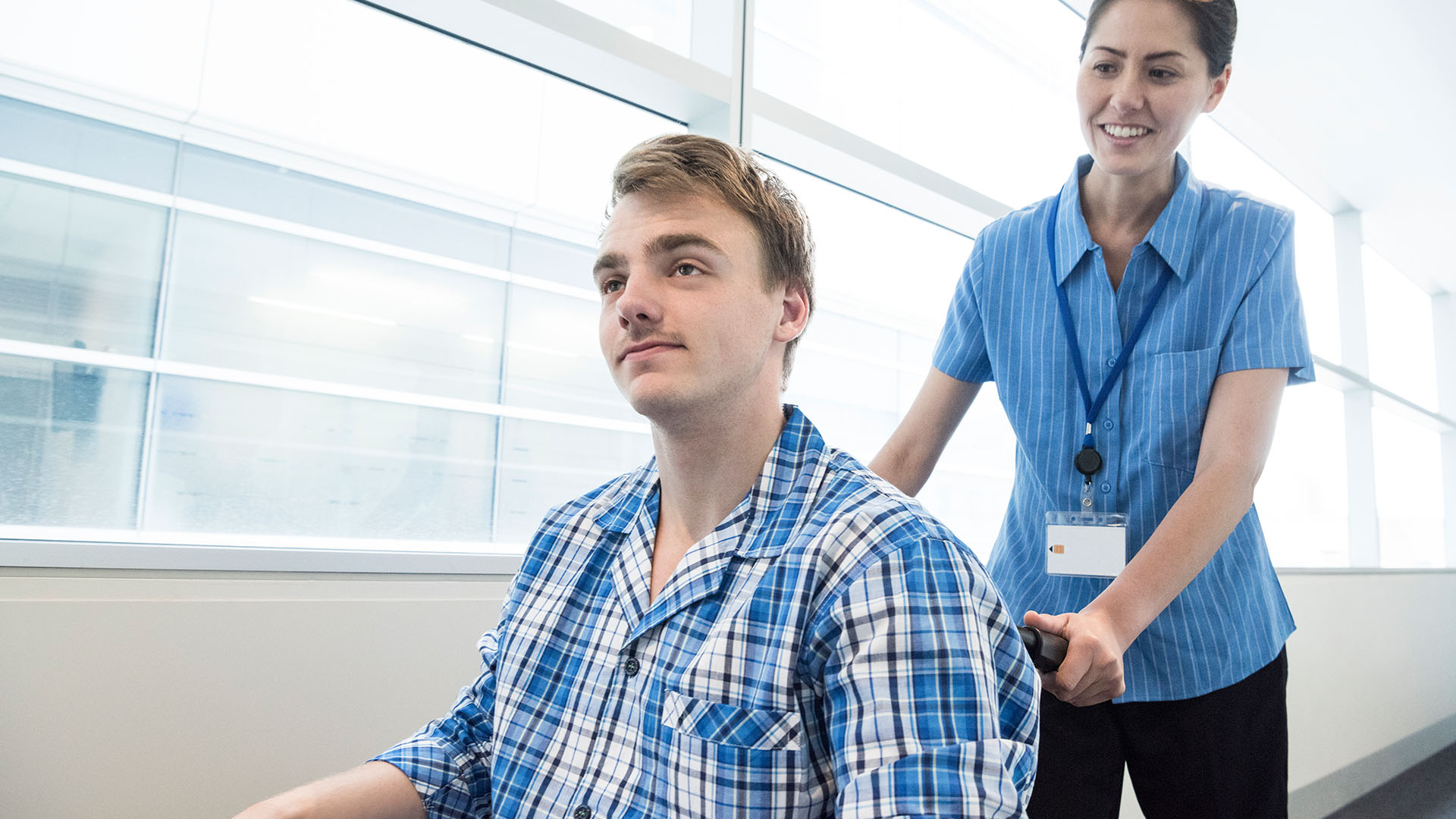
People handling is a hazardous manual task. It refers to any workplace activity where a person is physically moved, supported or restrained.
These tasks may expose workers to risk factors including:
- awkward or sustained postures
- high or sudden force, or
- sudden movements of the person being handled.
Examples of people handling tasks include:
- a security guard restraining a person behaving violently.
- a nursing assistant transferring a person from a bed to a chair without assistance in an aged care facility.
- a nurse supporting the leg of a patient with bariatric needs while dressing a wound.
- a community support worker helping a client to shower at home.
Most people handling activities have a high potential to cause injuries to workers if suitable control measures are not used.
You have specific responsibilities under WHS laws to manage MSD risks from hazardous manual tasks.
When deciding on controls, you must consider anything that could cause or contribute to an MSD, including:
- postures, movements, forces and vibration
- how long and how often a task happens
- workplace environmental conditions (such as temperature, lighting or noise) and how they might affect the task or the worker
- design of the work area (e.g. a nurse’s workstation or utility room in a hospital, or the home of someone receiving disability support)
- layout of the workplace (e.g. Is there enough space to use equipment such as hoists, walking aids, or larger chairs for patients with bariatric needs? Is the equipment appropriate? Does the facility need updating?)
- systems of work used (e.g. Are there enough workers for the task and have they been trained? Are there enough workers rostered on? Are there strategies to manage high job demands during busy periods? Are risk assessments conducted before providing service and before workers visit clients’ homes? Is there a requirement for a care plan for patients with bariatric needs?), and
- the nature, size, weight or number of persons, animals or things involved in a hazardous manual task (e.g. How often does people handling occur? How many objects need to be moved? Is the person being moved likely to be aggressive? Do they have any medical conditions impacting the task?)
Designers, manufacturers, importers and installers of equipment also have WHS responsibilities to reduce the exposure of workers to MSD risks from hazardous manual tasks.
For more information see Who has WHS legal responsibilities, Managing WHS risks, and Code of Practice: Hazardous manual tasks.
Risks related to hazardous manual tasks can be managed through good work design, and must follow the hierarchy of controls and involve effective consultation.
When managing the risks of people handling, you must consider the characteristics of the person being handled, and (where appropriate) consult with them, their family members or other carers or service providers to determine the best way to manage risks.
If handling a person creates WHS risks, you must eliminate or minimise risks as much as you reasonably can. MSD risks are not ‘part of the job’ for healthcare and social assistance workers and must be prevented wherever possible.
No worker should lift or restrain a person (other than a small infant) by themselves. You should provide appropriate transfer devices (such as hoists, raising aids, slides, or electric hospital beds) and ensure these are well-maintained. You should also provide enough workers to assist with people handling, and ensure they are trained to use and maintain equipment safely.
For more information see Consultation when managing WHS risks and Code of Practice: Work health and safety consultation, cooperation and coordination.
How you should identify and assess hazards and risks
Consult with workers and others to identify and assess hazards and risks
How you should control risks
Consult with workers and others to design controls
If risks cannot be eliminated, minimise risks as much as you reasonably can using the hierarchy of controls. The following are examples of controls for hazardous manual tasks:
- Eliminate the risks of MSDs where possible, including through good work design (e.g. design building with enough space for automated systems such as medication dispensers or sterile trolley washers).
- Substitute the hazard with a safer alternative (e.g. use microfibre mops instead of string mops, install a dishwasher to reduce the number of plates that need to be washed by hand, replace heavy wheelchairs with lighter ones, buy pre-sliced vegetables).
- Isolate the hazard from any person exposed to it (e.g. set up a physical barrier around a machine that produces harmful vibration or noise).
- Engineering controls (e.g. hoists, automatic beds, auto-pipettes in laboratories, wheelchairs and other assistive devices that reduce the need for patient handling, motorised trolleys).
- Administrative controls (e.g. develop a regular procedure for inspecting and maintaining equipment to ensure it remains safe to use, train workers in how to use equipment safely, improve rosters to reduce physical fatigue).
- Provide PPE (e.g. shoes with a good grip that will prevent workers from slipping when doing manual tasks)
Use a combination of control measures to effectively eliminate or minimise risks.
Maintain and review controls to ensure they are being used and are effective, especially after any changes to the task or workplace.
For more information see Code of Practice (WHSQ): Manual tasks involving the handling of people, and Transferring people safely: A handbook for workplaces (WorkSafe Victoria).
 Case study – People handling in aged care
A nursing assistant works in an aged care facility and their daily tasks involve people handling, performing care tasks, and using equipment. The aged care facility has a high number of residents with limited mobility, increasing the risk of injury to workers when performing people handling tasks.
The nursing assistant recently reported some shoulder pain to their supervisor. The management team was concerned and investigated by talking to workers, observing tasks, considering other hazards and risks in the workplace, and reviewing mobility assessments and various reports.
They found many of the facility’s hoists had not been maintained and could no longer be used safely. Staff had reported this but not all the equipment had been fixed or replaced. Due to staff shortages and work demands in providing prompt care for residents, workers felt they lacked the time to wait to use the limited number of working hoists, and so had been manually lifting people.
After consulting with their staff, the facility established a system and budget for inspecting, maintaining and replacing equipment. They reviewed the staff roster, which was found to be not properly accounting for routine staff absences. More staff were rostered on around times when residents were found to need more mobility support, such as mealtimes. They also formed a health and safety committee to ensure future WHS problems in the workplace were identified and acted upon.

Case study – Patient in home-based care
A newly qualified disability support worker was employed by a labour hire company to provide in-home support to a client. The worker, who had limited English language skills, was given a Support Plan for the client that included over 50 pages of detailed information related to their medical history and support needs. When they arrived at the home, the worker saw that assistive equipment was available, but they had not been trained to use it. The worker was unable to find the information they needed in the Support Plan. When the client needed to be moved, the worker attempted to use a hoist which had not been set up properly, and the client was injured.
A subsequent investigation found the worker had not been given adequate training, instruction and support, creating WHS risks. Following a risk assessment and worker consultation, the company developed safe work procedures requiring that new workers be paired with more experienced workers until they could demonstrate the required competencies in practice. The company designed a new template (with a two-page summary) for reporting the client’s support needs, which includes pictures for workers with lower levels of English.