Key messages
Identifying hazards and assessing risks involves:
- identifying things that could potentially cause physical or psychological harm
- consulting with workers and other people with work health and safety (WHS) duties
- finding out more about how the harm might occur, and
- looking at hazards and risks together to understand how they might interact or combine.
You must seek knowledge about ways to eliminate or manage risks. Ignorance of WHS issues in your workplace is not a defence. You should consult with workers and reach out to other organisations (e.g. equipment manufacturers) for information on effective controls to manage risks. In managing risks relating to individual patients or clients, you may need to seek information from other medical services or the patient’s family or carers.
Jump to:
How to identify hazards
You will need to use a range of methods and a variety of sources to identify hazards in your workplace. This includes reviewing data and reports (e.g. injury records, workers’ compensation claims), looking for trends, undertaking inspections, talking to workers and their representatives (through meetings or surveys) and thinking about the hazards associated with different aspects of work.
Some hazards may always be present in the workplace. Others may arise because of specific activities, or the nature of the work or services being provided. Some hazards may be present only when something goes wrong.
Make sure you have appropriate ways for workers to report hazards, risks, incidents and near misses, and actively encourage them to do so. Reporting gives you information that you can use to improve safety in your workplace. Just because workers have not reported hazards does not mean they are not present in the workplace.
Workers might not report hazards if they:
- see them as just part of the job
- believe they are not serious enough to report
- feel they do not have time to report them
- do not think safety is being treated as a priority in the workplace
- think their reports will be ignored, or not handled respectfully or confidentially
- fear they will be blamed or that reporting will disadvantage them in some way (e.g. disciplinary procedures, loss of work)
- do not know how to report a hazard or raise concerns
- think someone else will or should report it, or
- do not have a good understanding of health and safety or do not turn their minds to it.
You should promote a positive safety and reporting culture and make workers feel supported to speak up. You should also consider factors that may discourage workers from speaking up and address these (e.g. casual work arrangements, workers with low levels of English literacy or other communication barriers, cultural factors, newly arrived migrants or younger workers). These factors can be addressed by providing appropriate inductions and training, translated resources, adequate support and supervision, ongoing consultation and by creating a safe environment to raise concerns.
Aspects of work
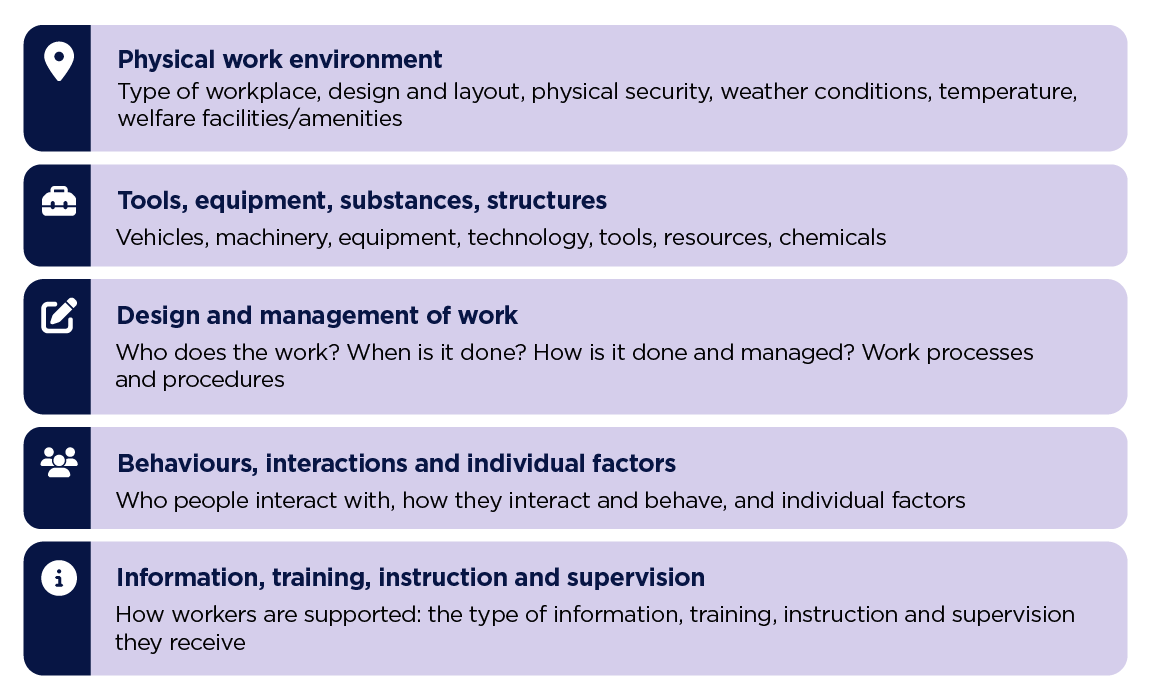
It is important to consider all aspects of work and assess how they may cause or contribute to risks in the workplace. This review should be ongoing, as safety is not a ‘set-and-forget’ exercise.
Figure 2: Aspects of work