Key messages
The following people have WHS legal responsibilities.
PCBUs, such as employers, platforms, sole-traders or contractors Officers Workers Designers, suppliers, manufacturers, importers and installers Others
PCBUs
PCBU is a broad term that captures different kinds of working arrangements.
This Code’s main target audience is PCBUs. The Code uses the word ‘you’ throughout to refer to PCBUs.
Information on who a PCBU is can be found below.
PCBUs may include:
- Employers, sole traders, contractors and other businesses
- hospitals, aged care facilities and disability support service providers (including government and privately owned entities)
- government departments and authorities (e.g. state and territory health departments)
- platforms that provide care or support workers under ‘gig’ arrangements
- training providers (e.g. specialist medical colleges)
- Intermediaries (e.g. support coordinators, navigators) and labour hire firms
- designers, importers, suppliers or manufacturers
- people who manage or control facilities (e.g. facilities managers), and
- sole traders and self-employed people, such as owners of a general practice, people offering allied services within a hospital, or support workers providing in-home care.
If it is not clear who the PCBU is in your workplace, you should seek legal advice or contact your local WHS regulator.
Sole traders or self-employed people can be both PCBUs and workers at the same time. A sole trader or self-employed person is a PCBU if they are conducting a business or undertaking.
At the same time a sole trader or self-employed person is a worker if they do any type of work for a PCBU.
As a PCBU they have a range of WHS legal responsibilities, including the primary duty.
For example, a self-employed surgeon must eliminate or minimise WHS risks for their workers and other people affected by the work as much as they reasonably can. The surgeon also owes a primary duty to any workers or subcontractors they engage, direct or influence (e.g. medical receptionists at surgery suites).
For more information, see the guidance on WHS duties in a contractual chain.



Workers that PCBUs owe a duty to include people they directly employ or engage (e.g. employees, contractors, students on placement or gaining work experience and volunteers).
However, there does not need to be a direct contractual relationship between a PCBU and the workers for the PCBU’s legal responsibilities to apply. A PCBU’s workers may also include people doing work for them through subcontracting, labour hire, platforms or similar arrangements.
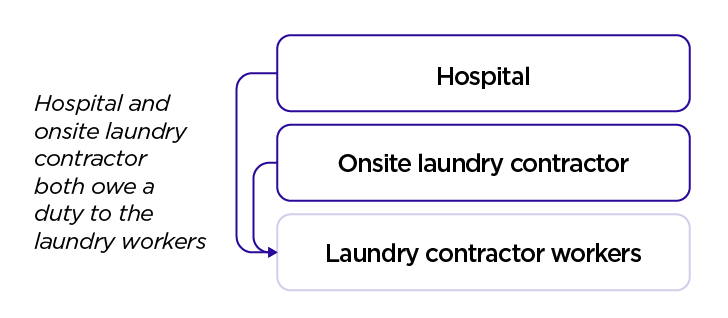
For example, if a hospital (as a PCBU) contracts an on-site laundry service, the laundry service’s workers are also the hospital’s workers. The hospital has WHS legal responsibilities for these workers, as it caused the workers to be engaged when it contracted the laundry service to perform the laundry work. In this case, both the hospital and the laundry service have WHS legal responsibilities to the workers, and these responsibilities are shared.
Figure 1: Example of how WHS duties can be shared
Under WHS laws, a PCBU has the main legal responsibility for keeping people safe in a workplace. This responsibility is known as the ‘primary duty’.
Under the primary duty, if you are a PCBU, you must:
- ensure the health and safety of workers when they are at work, and
- ensure the health and safety of others who may be at risk from the work (such as patients, clients or visitors).1
The primary duty applies ‘so far as is reasonably practicable’. This means doing as much as you reasonably can to keep people safe.
To meet the primary duty, you must eliminate health and safety risks at work. If you are not reasonably able to eliminate risks, you must minimise these risks as much as you reasonably can.2

Worker safety vs patient or client care
Patient or client care, support or preferences do not take priority over worker safety. WHS legal requirements exist to protect workers and others from WHS risks, and these requirements cannot be ignored because of an actual or perceived conflict with patient or client care.
Because their job is to care for others, it is common for people in the healthcare and social assistance industry and their managers to prioritise patient or client care. This sometimes even includes putting the preferences of patients, clients or family members above the safety of workers. For example, a patient may prefer to be carried by a worker and not moved with lifting equipment. This may pose a risk to the worker and the patient.
You must fulfill your WHS legal obligations. You should also communicate with workers, patients, clients and their families about the importance of protecting workers’ health and safety.
For example, nurses sometimes must care for patients living with dementia who are behaving violently and may not be able to control their behaviour. This behaviour represents a WHS risk to the nurse. In some circumstances, it may be appropriate to refuse care to the patient. In other cases, the nurse’s employer may not reasonably be able to eliminate the nurse’s exposure to WHS risk, because the patient still requires care. However, the nurse’s employer must still minimise WHS risks as much as they reasonably can by providing controls that prevent the nurse from being injured, such as caring for the patient in a specialised ward, rostering on enough staff to care for the patient safely, arranging a medical review, providing training in de-escalation techniques or time to debrief to review practice or incidents.
You have a duty to consult with workers, and their Health and Safety Representatives (HSRs) if they have them, on health and safety matters. You also have a duty to consult with people who share a duty for the same matter (e.g. a security guard working for a private security company but contracted to work in a hospital may be owed a duty by both the security company and the hospital). For more information see the consultation section of this Code and the Code of Practice: How to manage work health and safety risks.

Note references to consultation with workers in this Code includes consultation with any HSRs.
Officers
Officers have specific duties under Work health and safety laws.3
The role and influence a person has in an organisation determines if they are an officer under the model WHS laws. This may be different for each organisation.
Who is an officer in the healthcare and social assistance industry?
Officers may include owners and operators of facilities, hospital directors, senior executive board members, and other members of the senior leadership team.
A person may be an officer if they:
- are the owner or operator of a small business or organisation
- make big decisions about all or part of the business or organisation, or
- can affect the business or organisation’s financial standing.
Officers have a duty to exercise due diligence to ensure the employer or organisation complies with its duties. Due diligence includes taking reasonable steps to:
- acquire and keep up-to-date knowledge of the WHS matters of the organisation, such as an understanding of the nature of the employer or organisation’s work and common hazards and risks
- ensure the organisation has enough resources and processes to eliminate or minimise risks to health and safety and verify those resources are being used, and
- ensure the organisation has appropriate processes for receiving and considering information regarding incidents, hazards and risks to health and safety, verify those processes are effective and respond in a timely way to that information.
For information on officers and their duties see the Interpretive Guideline: The health and safety duty of an officer.

Note: Just because a person’s job title has ‘officer’ in the name, this does not necessarily mean they are an ‘officer’ under WHS laws.
Workers
Under Work health and safety laws, workers have a duty to take reasonable care of their own health and safety. They must also take reasonable care of the health and safety of others.
Workers must also comply with reasonable health and safety instructions, as much as they reasonably can, and cooperate with reasonable health and safety policies or procedures that have been communicated to them.
Who is a worker in the healthcare and social assistance industry?
The term ‘worker’ includes anyone who does work for a Person conducting a business or undertaking, including employees, contractors, subcontractors, agency staff, managers, apprentices, ‘gig’ workers, trainees, students on placement and volunteers.
The WHS duties listed above apply to all workers. Every worker in healthcare and social assistance is covered by WHS laws no matter how they are engaged or their visa status. As you read this Code think about all the workers at your workplace. You may have clinical staff such as general practitioners, surgeons, nurses, midwives, medical assistants, ambulance workers, allied health workers, disability support workers, and students on placement; and non-clinical staff such as security guards, frontline support staff, receptionists, kitchen and laundry workers, and maintenance workers.
Workers can take an active role in managing WHS risks in the workplace, including by helping you identify hazards, understand and assess risks, and design appropriate controls. However, you retain the primary responsibility for managing WHS risks.
For some workers, the health and safety instructions they must comply with might be as simple as not entering certain areas, or only operating equipment they have been trained to.
Other workers may have more significant and broader-ranging responsibilities for WHS. For example, executives and managers may be instructed to develop health and safety processes for their unit, or for identifying and responding to new and emerging hazards on behalf of their employer. They may be responsible for handling high risk situations, according to their level of experience and training. In these cases, you still retain your WHS legal responsibilities, but the worker may have a significant role in supporting their organisation to meet them.
Designers, suppliers, manufacturers, importers and installers
Designers, suppliers, manufacturers, importers and installers must ensure, as much as they reasonably can, that buildings, equipment and technology used as or at a workplace do not create work health and safety risks.
Designers, suppliers, manufacturers, importers, installers and their clients must consult each other on the risks and work together on appropriate design solutions, for example:
- manufacturers to consult with designers of equipment
- importers to consult with designers and manufacturers of equipment, and
- the person who commissions construction work to consult with the designer of the structure such as a hospital building.
Designers have a very important role in preventing WHS risks. This is because addressing risks in the design phase is often the most effective way of eliminating risks to health and safety.
For more information see the Code of Practice: Safe design of structures and the Code of Practice: How to manage work health and safety risks.

Case study – Designer duty
An architect is asked to design a new aged care home. Their client asks them to create a ‘facility that will make residents feel like they are at home’ while ensuring it has suitable equipment for people handling tasks. In consulting on the design, the architect realises that many residents of the facility have health conditions that reduce their mobility as they age, requiring staff at the facility to help them get around. Following a risk assessment and considering the facility design, the architect and aged care provider agree to install ceiling hoists into the aged care home, which ultimately prevents many injuries among staff at the facility that would otherwise have been caused by manual people handling. While some residents prefer not to have ceiling hoists as these make them feel less ‘at home’, both the architects and the aged care provider have a duty to prevent worker injuries.
Others
Other people at the workplace, such as patients, clients, their families and visitors, must take reasonable care for their own health and safety and the health and safety of others.
Others at the workplace must also comply with reasonable health and safety instructions you give them as much as they reasonably can. This includes following any verbal instructions given at the workplace or following written instructions such as signs.
Case study – Others in the workplace
A disability support worker attends a client’s home to assist them with self-care tasks. The client wants to be moved from their bed to a lounge so they can watch television. Lifting equipment is usually used when transferring the client from the bed to the chair. On this visit, the lifting equipment is unavailable as it is being repaired.
The father of the client suggests that he will help the worker to lift his daughter. However, the support provider has a policy of not conducting manual lifts because of the risk of injury to workers. The father insists his daughter be moved and encourages the worker to ignore their policy in this instance. The worker calls their supervisor, who explains to the father that manually lifting the client will create a risk for both the worker and the father.
1Model Work Health and Safety Act s 19.
2Model Work Health and Safety Act s 17.
3Work Health and Safety Act 2011 s 27.