Our approach
The Research and Evaluation Strategy provides the framework for Safe Work Australia’s research and evaluation activities. It guides how we prioritise, design and deliver research to ensure it is nationally relevant, coordinated and policy-focused.
The Strategy supports a forward-looking research agenda that anticipates emerging issues, addresses national priorities, and strengthens connections across the research ecosystem to maximise impact.
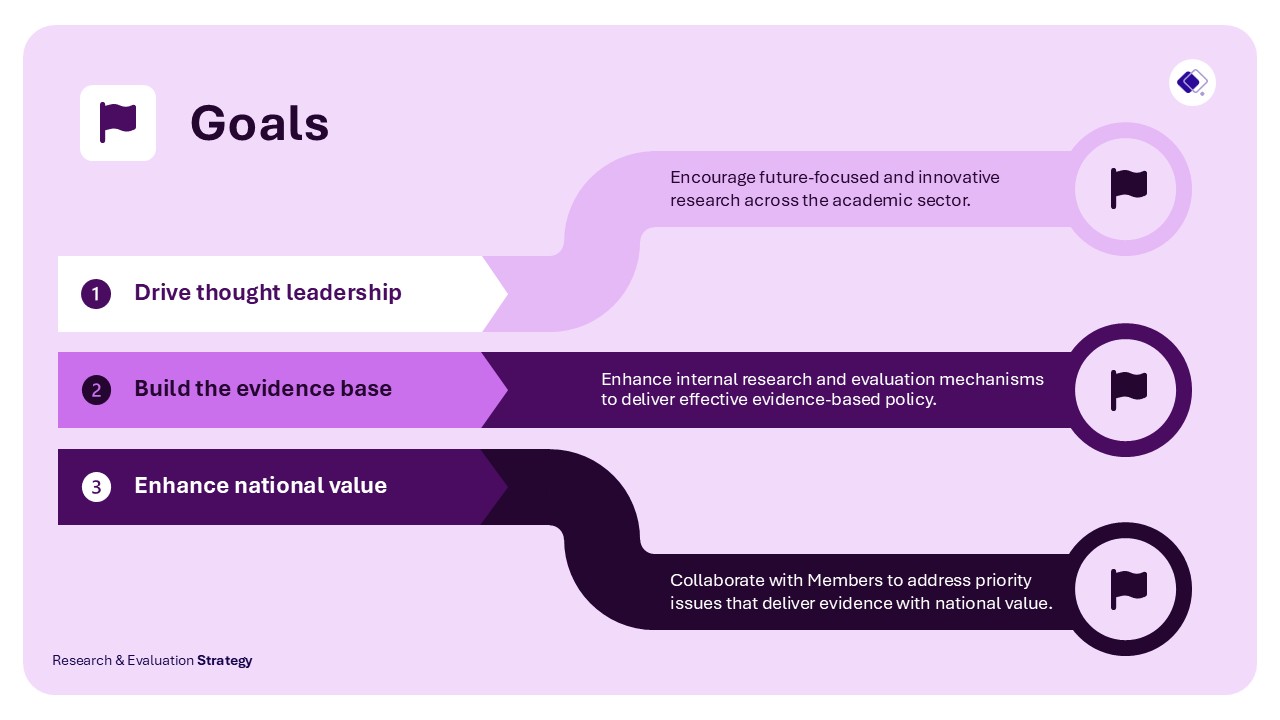
Our goals
The goals set out in the Strategy aim to:
- strengthen the national evidence base for WHS and workers’ compensation
- support evidence-informed policy decisions
- improve outcomes for workers and employers through practical, policy relevant research.
Read the Research and Evaluation Strategy.
Annual research workplan
Safe Work Australia’s annual research workplan is shaped through consultation with the national WHS and workers’ compensation research ecosystem.
The workplan reflects current priorities and planned activities, while retaining the flexibility to respond to emerging issues and changing evidence needs.
Our research priorities are informed by engagement across academia, governments, unions, industry and employer groups, and health and safety professionals, including insights from our inaugural Research Summit.
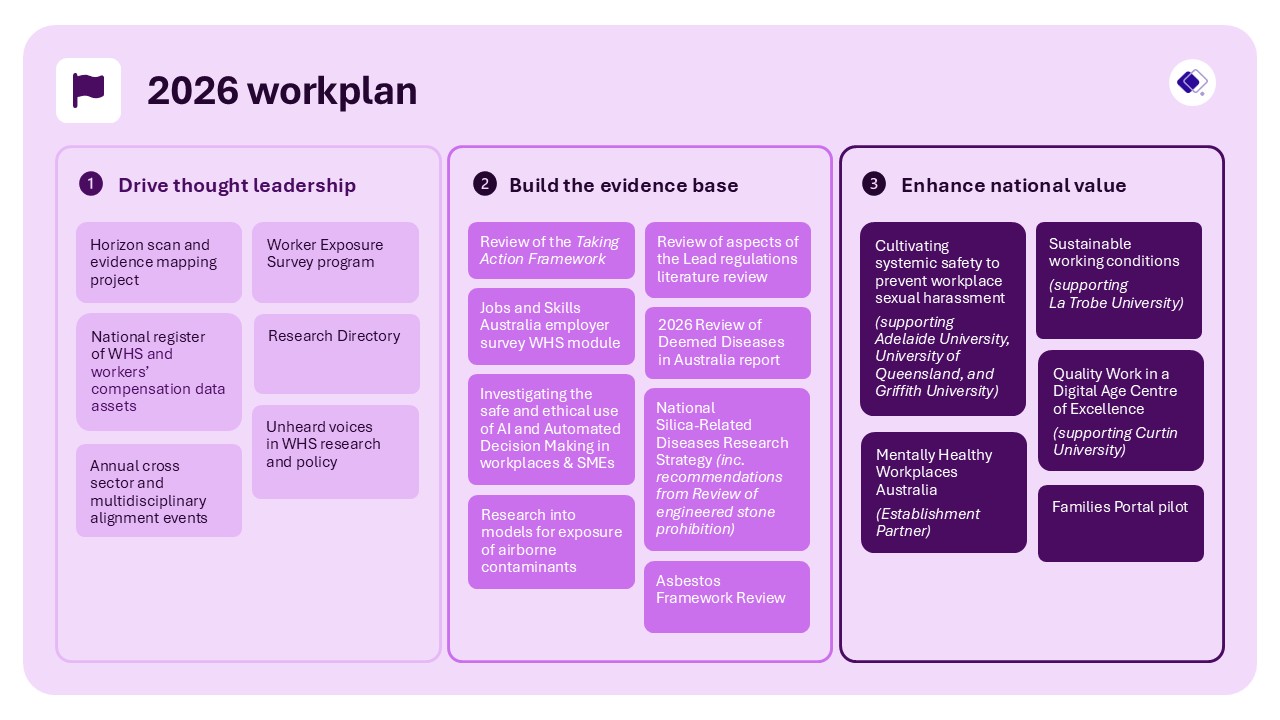
The 2026 research workplan builds on Safe Work Australia’s continuing research activities that support policy development. It also introduces new activities designed to directly advance the Research and Evaluation Strategy’s goals and deliver evidence with national value.
View PDF in a new tab
2026 workplan – text version
Drive thought leadership projects
- Horizon scan and evidence mapping project: Systematic mapping of work health and safety (WHS) and workers’ compensation evidence to identify trends, risks and opportunities aligned with the Strategy’s five focus areas.
- National register of WHS and workers’ compensation data assets: Consolidating information on WHS and workers’ compensation datasets in one place to support national data sharing, transparency and equitable access.
- Annual cross sector and multidisciplinary alignment events: Facilitating collaboration across disciplines and sectors. In 2026, this will include 2 SWA-led events.
- Worker Exposure Survey program: Data collection and research activities in relation to the delivery of the Australian Worker Exposure Survey (AWES).
- Research Directory: Mapping national WHS research expertise, projects and institutions to support collaboration and reduce duplication.
- Unheard voices in WHS research and policy: Ensuring workers typically under‑represented in WHS research are meaningfully included in evidence‑building activities.
Build the evidence base projects
- Review of the Taking Action Framework: Revise and publish the updated Framework to reflect the findings of the evaluation and supporting research.
- Jobs and Skills Australia employer survey WHS module: Including a set of new WHS questions to better understand employer workplace health and safety policies, practices, and attitudes.
- Investigating the safe and ethical use of artificial intelligence (AI) and automated decision making (ADM) in workplaces and for SMEs: Identifying potential WHS risks from AI and ADM, understanding how they interact with the WHS laws and potential limitations of the laws.
- Research into models for exposure to airborne contaminants: Exploring models for characterising occupational inhalation exposure to airborne contaminants and their suitability for the Australian regulatory context and for airborne contaminants without a workplace exposure limit.
- Review of aspects of the Lead regulations literature review: Undertaking an evidence review and stakeholder consultation to provide expert advice on questions relating to lead exposure in the workplace.
- 2026 Review of Deemed Diseases in Australia Report: Reviewing the latest scientific evidence about the causal link between occupational exposure and diseases to make recommendations on amendments to the Deemed Diseases List.
- National Silica-Related Diseases Research Strategy: Using findings from the engineered stone prohibition review, develop a National Silica-Related Diseases Research Strategy (NSDRS) with Department of Health.
- Asbestos Framework Review: Continuing national efforts to eliminate asbestos-related diseases in Australia and focusing on practical steps to safely remove old asbestos-containing materials from buildings.
Enhance national value projects
- Cultivating systemic safety to prevent workplace sexual harassment (supporting Adelaide University, University of Queensland, and Griffith University): Examining how organisational systems, structures and cultures influence the risk of workplace sexual harassment and developing practical tools for prevention.
- Sustainable Working Conditions (supporting La Trobe University): Aiming to test a conceptual model for sustainable working conditions, with a particular focus on gender and older workers, to improve safe and healthy work and return-to-work outcomes.
- Mentally Healthy Workplaces Australia (Establishment Partner): National collaboration to improve mental health, safety and wellbeing at work through evidence-based tools and resources.
- Quality Work in a Digital Age Centre of Excellence (supporting Curtin University): Exploring how digital transformation affects job quality and identifying ways organisations can design technology-enabled work that is healthy, inclusive, and productive
- Families Portal pilot: Development and pilot implementation of a centralised online hub for families affected by workplace fatalities.
Research partnerships
Safe Work Australia supports research partnerships that deliver national benefits by strengthening the evidence base for policy and enabling practical, innovative outcomes.
We welcome opportunities to participate in strategically aligned, consortium‑led research through in-kind support, particularly where projects address priority evidence gaps and contribute to nationally consistent outcomes.
Please note that Safe Work Australia does not operate research grant schemes at this time.
Examples of the projects we’re involved in, and our upcoming partnerships are outlined below.
| Organisation | Project | About |
|---|
| Adelaide University, University of Queensland, and Griffith University | BRIDGES at Work | Partner Organisation on this project examining how organisational systems, structures and cultures influence the risk of workplace sexual harassment and developing practical tools for prevention. |
| La Trobe University | Sustainable working conditions: Requirements to enable long working lives [DP: 250100393] | Advisory Committee member for this ARC Discovery Project aiming to test a conceptual model for sustainable working conditions, with a particular focus on gender and older workers, to improve safe and healthy work and return-to-work outcomes. |
| Mentally Healthy Workplaces Australia Establishment Partners | Mentally Healthy Workplaces Australia | A national centre collaboratively developing impactful and integrated workplace mental health, safety and wellbeing innovation and research, driven by Australian workplace and worker needs now and into the future. |
| Curtin University | Quality Work in a Digital Age Centre of Excellence | Partner Organisation on this program exploring how digital transformation affects job quality and identifying ways organisations can design technology-enabled work that is healthy, inclusive, and productive. |
Contact us
For information about research at Safe Work Australia, email ResearchEnquiries@swa.gov.au.
You can also subscribe to receive updates including new publications, partnerships and events.