Key messages
You must eliminate risks if you reasonably can. The most effective way to control risks is to eliminate them completely. For example, stop doing a task or remove the hazard from the workplace.
You may be able to eliminate certain risks for some workers, in some areas of the workplace or for specific tasks.
If it is not reasonable to eliminate risks, you must minimise them as much as you reasonably can. This means applying controls until the risk is minimised as much as it reasonably can be.
Brainstorm all possible things that can be done to manage the risk.
Talk to your workers about possible controls and what might work best. Workers will have good ideas or insights based on their knowledge and experience.

Consider whether the work environment or systems of work can be re-designed to eliminate or minimise the risk arising from exposure to the hazard.
You should also think about measures you can take to make controls more effective, or as a backup if processes and procedures are not followed properly (e.g. a wheel maintenance program that ensures all wheeled equipment works smoothly).
From the possible controls you have talked about, use the hierarchy of controls and consider which control or combination of controls will be most effective and reliable.
What if the risk is already known and controls are already well-established?
A full assessment of the hazard and its risk may not be required if there are well-known and effective controls available. If this is the case, you can simply implement the known controls.
You must first eliminate the risks if you are reasonably able to. The best way to do this is to identify controls that eliminate the hazard completely. For example, the use of automated dispensing technology (e.g. in-pharmacy robotics and automated dispensing cabinets) in hospital pharmacy departments.
Not all elimination measures will be reasonable. For example, it may not always be reasonable to eliminate exposure to harmful behaviours from patients or members of the public if this means care cannot be delivered. However, risks resulting from these behaviours must still be minimised as much as you reasonably can.

Case study – Considering controls
An aged care provider identifies that there is a risk of a resident being exposed to burns when making their own cups of tea or coffee. The risk could be eliminated by removing access to tea and coffee making facilities. However, the Aged Care Quality Standards include the ‘dignity of risk’ principle (‘people in aged care have the right to live the life they choose even if it involves some risk to themselves’). This means it may not be reasonable for the provider to eliminate the risk of burns. However, consistent with both the work health and safety (WHS) and Aged Care legislative frameworks, the risk must still be minimised by implementing other controls. For example, alternative equipment could be provided to reduce the risk, such as an insulated urn (so residents do not have to lift a heavy kettle) or two-handled mugs which are less likely to be spilled.
You should select controls (or combinations of controls) based on their effectiveness.
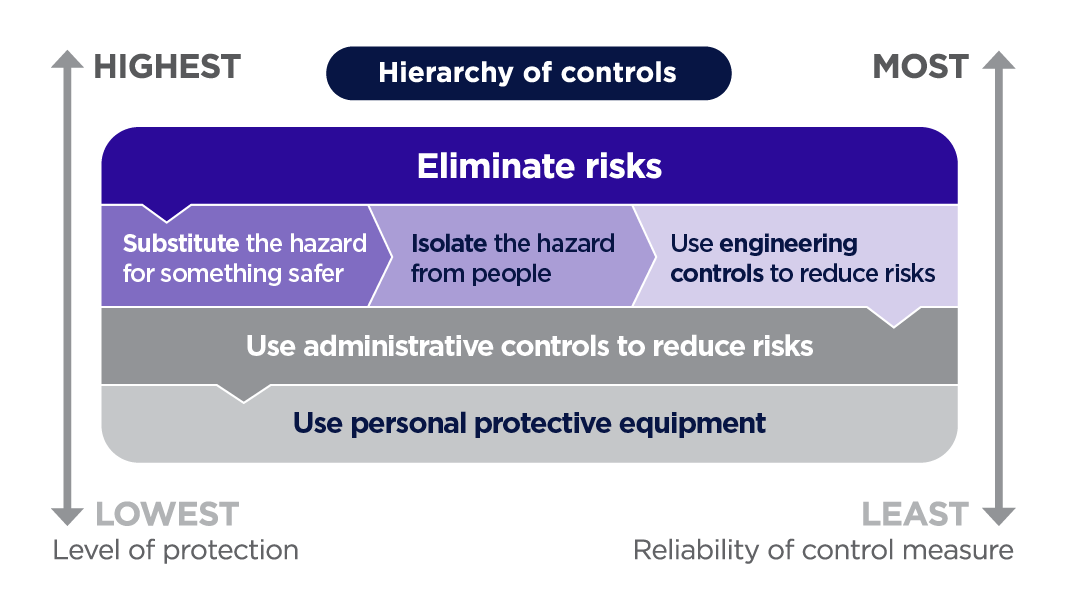
The hierarchy of controls helps rank controls from the highest level of protection and reliability to the lowest. It will help you to think about why a risk exists in the first place and consider whether you can redesign a given task to make work safer. It will also help you select the most appropriate control, or combination of controls for the risk.
Figure 3: The hierarchy of controls
Using the hierarchy of controls
First, you must consider whether a risk can be completely eliminated from the workplace. For example, use automated floor cleaning devices that eliminate the need for workers to clean floor surfaces.
If there is not a reasonable way to eliminate risks, you must minimise risks as much as you reasonably can by doing 1 or more of the following:
- substituting hazards or risks with something safer (e.g. replacing a hazardous chemical with a non-hazardous one)
- isolating hazards or risks from people, including physically separating a person from a hazard (e.g. by keeping infectious patients in a separate ward), and
- using engineering controls such as a mechanical device or process (e.g. needle-free connection systems to prevent needle-stick injuries).
After you have applied all reasonable substitution, isolation and engineering controls, consider if risks remain.
If so, use administrative controls, such as training, supervision, work methods or procedures, or warning signs.
If you have applied all reasonable administrative controls, consider if risks still remain.
If so, use personal protective equipment (PPE).
Administrative controls and PPE are the least effective controls as they rely on human behaviour or supervision to work.
For example, policies and procedures to manage hazardous tasks only remain effective if workers consistently follow procedures and do not make mistakes.
It is okay to use administrative controls and PPE when they are combined with other more effective controls (as a back-up). For example, patients suspected of having an infectious disease may need to be isolated from others, and workers caring for them may need to wear a fit-tested face mask, gloves and gown.
If not used in combination with other controls, administrative controls and PPE should only be used:
- as a short-term interim measure until a more effective way of controlling the risk can be used, or
- when there are no other controls available (as a last resort).
You should make sure the controls you use do not introduce any additional hazards or risks. For example, a robot vacuum cleaner may reduce risks related to cleaning by people but may pose a trip hazard.
'Reasonably practicable' is a legal requirement under WHS laws. It means doing everything you reasonably can to keep workers and others in the workplace safe.
When you are using controls to manage WHS risk, the control (or combination of controls) must:
- provide the highest level of protection for people and be the most effective and reliable (i.e. controls located towards the top of the hierarchy of controls)
- be available to use in the workplace, and
- be suitable for your workplace and your workers.
The cost of eliminating or minimising risk is relevant in determining what is reasonably practicable. However, there is a clear presumption in favour of safety over cost. Choosing a low-cost option that provides less protection simply because it is cheaper is unlikely to be considered a reasonably practicable way of eliminating or minimising risk. The cost of eliminating or minimising risk must only be taken into account after identifying and assessing the risk and the available ways of eliminating or minimising the risk.
If your organisation faces resourcing pressures this does not remove your legal responsibilities to manage WHS risks.

You should also consider other legislative requirements or standards that may influence or contain information about how to manage risks.
Sometimes, how you manage risks may need to comply with both WHS laws and other legal frameworks at the same time.
Designing the workplace and the work itself so that it is free from WHS hazards is the best way to prevent work-related fatalities, injuries and illnesses. This process is known as ‘good work design’.
Good work design can address the root causes that contribute to risk, meaning you do not need to rely on less effective controls (such as influencing human behaviour).
To be most effective, good work design should begin at the earliest possible opportunity (e.g. when designing a new work task or a new building). It should also be considered whenever there are changes to work or the work environment.
Things to consider for good work design
The work: how work is performed, including the physical, mental and emotional demands of tasks and activities, the duration, frequency and complexity of tasks, and the context and systems of work.
Physical environment: the workplace itself, the equipment, materials and substances used, and the vehicles, buildings and structures.
Systems and processes: including information technology, business management, products and services, supply chains, and human interaction, including with patients or customers.
Workers: their physical, emotional and mental capacities, preferences and needs
Essentially good work design requires you to consider all aspects of work and how they are designed and interact with each other.
The below video provides an example of using good work design to address work-related violence and aggression in NSW hospitals. It does not demonstrate all features of good work design to address other hazards.
For more information, see the following resources:
- Safe Work Australia’s resources on good work design
- the Code of Practice: Safe design of structures, and
- the Code of Practice: How to manage work health and safety risks.