Key messages
Psychosocial hazards are common in the healthcare and social assistance industry and can cause psychological harm. The specific psychosocial hazards workers are exposed to, and how they are exposed, varies between workplaces and roles. Psychosocial hazards may interact or combine to create new, changed, or higher risks, so they need to be considered together when managing risks.
Just because psychosocial risks are common at your workplace, it does not mean they can be treated as ‘part of the job’ and ignored. You must identify, assess and control the risks caused by psychosocial hazards. You must eliminate or minimise these risks as much as you reasonably can.
The best way to do this is to prevent psychological harm from happening in the first place. Initiatives aimed at improving worker well-being, such as counselling or Employment assistance program (EAP) services, are aimed at responding to psychological harm that has already occurred, instead of preventing it. These do not meet your duty to eliminate or minimise psychosocial risks to workers.
See the Code of Practice: Managing psychosocial hazards at work for more information.
Jump to:
How you should identify and assess hazards and risks How you should control risks Case study: Harmful behaviours Case study: Day surgery clinic in a private hospital
Psychosocial hazards are work-related hazards that can cause psychological (as well as physical) harm.
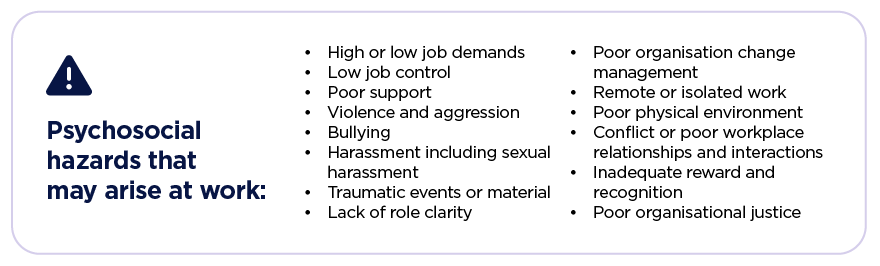
Table 1 below sets out common psychosocial hazards in the healthcare and social assistance industry. Psychosocial hazards may be described and grouped differently. The language is not as important as ensuring you identify what could cause harm and manage the risks.
Table 1: Common psychosocial hazards in the healthcare and social assistance industry
| Type of psychosocial hazard | Examples |
|---|---|
High job demands Sustained or intense high levels of physical, mental or emotional effort that creates stress.
A job can include periods of high and low job demands and a combination of mental, emotional and physical demands. | Physical demands Inadequate worker to patient ratios or client pressure to work faster or not take breaks. Inadequate time, resources and staffing allocated to tasks. Being discouraged by managers, or through a personal sense of duty, from taking time off due to limited staffing. Being under pressure to deliver care to each patient within a strict time limit leading to tasks being done too fast and causing risk of physical injury. Insufficient staff for safe patient handling or to respond to aggression. Mental demands Having too much to remember, without systems in place to help record information and provide reminders at the right time. Not having sufficient time to think about how to approach a difficult, complex or high-risk situation or how to prioritise competing tasks. Providing care to multiple people with complex needs and comorbidities, creating a high-stakes fear of error, particularly when combined with a lack of support or guidance from supervisors. Emotional demands Responding to distressing and emotional situations or providing support and empathy to people in need (e.g. communicating a difficult diagnosis). Exposure to traumatic events or material (e.g. providing care to victims of abuse or violence, or patients with a short life expectancy). Being concerned about being blamed if things go wrong. Having to rapidly switch between emotional situations (e.g. a midwife working with a woman in labour, a woman losing a planned pregnancy, and a planned termination around the same time). |
Low job control Workers having limited control over the work, including how and when it is done. | Micromanaging work, including intense oversight, surveillance and control over how work is done, particularly in absence of strong reasons for this or when levels of autonomy do not match a workers’ abilities. Workers have limited ability to adapt the way they work or apply their judgement. Lack of consultation about changes that impact work. Workers feel unable to advocate for patients or clients at due to fear of reprisal. |
Poor support Not being given enough support, including from supervisors or other workers, or not having the tools or resources to do the job. | Not being able to ask for help or discuss issues at work. Having a supervisor who is too busy or stressed to assist you or answer questions. Not having enough support or workers to meet responsibilities Having faulty, outdated, or dangerous equipment, such as mobility equipment that needs repairs and is crucial to patient care. Incomplete, inconsistent or confused patient information. (e.g. not having clear records or instructions, lack of information sharing between services). Remote or isolated work where access to support is limited. Lack of fairness in decision-making and interactions. For example, providing critical feedback in front of others, or allocating shifts unfairly. Lack of managerial support for reporting work health and safety (WHS) concerns and the prospect of reprisal action. Not having enough workers to do the work safely. |
Harmful behaviours from other workers This includes:
Note: Harmful behaviours from others in the workplace (e.g. patients, clients) are covered in the next section. See also the Code of Practice: Sexual and gender-based harassment at work | Abusive, humiliating comments and conduct (e.g. making offensive comments about personal life in a work setting, isolating and ignoring, name calling, rumours, practical jokes). Undermining someone’s work, unreasonable performance expectations, unjustified criticisms or complaints. Inappropriate work scheduling or withholding of information. Unwelcome conduct including unwelcome touching, inappropriate staring and intrusive questions. Frequent rudeness, incivility and hostility (e.g. not acknowledging others, facial expressions and eye rolling, impatience and ‘snappy’ responses). |
Traumatic events or material Reading, hearing or seeing traumatic events or material, including abuse or neglect. Experiencing fear or extreme risks to the health or safety of themselves or others. Note: A person is more likely to experience an event as traumatic when it is unexpected, is perceived as uncontrollable or is the result of intentional cruelty. This includes vicarious (e.g. second-hand accounts) exposure and cumulative (e.g. repeated) trauma. | Providing care to victims of abuse or violence or communicating with their families. Providing care to patients with a short life expectancy or communicating with their families. Witnessing the death of a patient, especially when unexpected. Being exposed to violence or threats of violence. This could be from patients or other people (e.g. family members) at work. Inexperienced workers providing care or treatment to seriously injured or ill patients for the first time or where their usual duties involve minor injuries or illnesses. |
Remote or isolated work Working in locations with long travel times, or where access to help, resources or communications is difficult or limited. | Providing home-based care away from a supervisor and without support from other workers. Performing work alone and not being given a means to reliably communicate with other workers when support is needed. Driving long distances to work from different locations including clients’ homes. Working in a location far away from supplies or resources needed, including in a large facility or hospital. |
Workers may use different language to describe psychosocial hazards. For example, they might say they feel:
- stressed, burnt-out8 or emotionally exhausted about their workload
- anxious or scared about talking to or dealing with an aggressive person
- humiliated, degraded or undermined by sexual harassment or discrimination
- angry about policies being applied unfairly
- confused about what their role involves, torn between competing priorities or ‘feeling like a failure’ for not being able to meet unrealistic expectations, or
- distressed, unable to sleep, or upset by exposure to traumatic situations.
You must manage the risks of psychosocial hazards in the workplace by eliminating them as much as you reasonably can. If you are not reasonably able to eliminate risks, you must minimise them as much as you reasonably can.
When deciding on controls for psychosocial risks, you have a specific legal duty to consider:
- how long, how often and how severely workers are exposed to psychosocial hazards
- how psychosocial hazards interact or combine with each other
- the design of work, including job demands and tasks
- systems of work, including how work is managed, organised and supported
- the design, layout, and environmental conditions of the workplace and workers’ accommodation, including safe entry and exit and facilities (e.g. bathrooms) for the welfare of workers
- the equipment, substances and structures at the workplace
- workplace interactions or behaviours, and
- information, training, instruction and supervision provided to workers.
These factors will impact the risks in your workplace and will therefore assist you to find the best controls.
Case Study
Mary visited a man each week to clean his house. One week when she visited, his son was there. He told Mary he was recently out of jail for abusing his wife. He went on to say all women were trouble and deserved what they got. At the time Mary was in a room and the man stood between her and the door. She felt extremely vulnerable and left the house as soon as she could. Mary immediately contacted her Manager.
The Manager visited the client when the son was out. The client said his son was staying with him until he found a place to stay. The client could not guarantee his son would not be present during worker’s visits. The service (which was not an essential health service) was withdrawn until the son moved out
Case study taken from page 36 of Community Workers Work health and safety guidelines, SafeWork SA, 2014
When considering the matters above, you might think about how you can improve systems of work (deciding when and where specific tasks are done, which workers do tasks and with who), management of work (ensuring clear reporting structures and risk management plans in place) and support for workers (what equipment they need, working in pairs, providing backup in high-risk situations, and establishing post-incident de-briefings).
You might also think about how other hazards in the workplace, such as high job demands, are increasing the risk to workers when combined with the risks from harmful behaviours, such as bullying and harassment.
Information, training, instruction and supervision may be necessary to implement controls effectively. They may also assist in controlling some psychosocial risks, for example where low role clarity is creating a risk, information and training on the worker’s role will help.
You will often need to use a combination of controls to effectively eliminate or minimise risks.
You must continually monitor and review controls to make sure they are working effectively and reliably. Some control measures may introduce new risks which must also be managed as much as possible. New hazards and risks might arise which means control measures may need to change to ensure WHS risks are prevented.
Short versus long-term controls
In the short term, you may implement controls such as adjusting rosters, extending shifts, redeploying staff internally, and deferring and delaying tasks until they have the resources.
However, over the longer term, you will have a broader range of actions you can take to meet your WHS duties – and you must take those actions if you reasonably can.
For example, while extended hours for existing staff or closing beds may be reasonable in the short term, over the longer-term there are a range of other options that can be used to further minimise risks, such as employing additional staff. And, if the risks to workers and others increases when exposure to psychosocial hazards is prolonged, it will be reasonable to do more to control the risk.
How you should identify and assess hazards and risks
Consult with workers and others to identify and assess hazards and risks
Examples of common psychosocial hazards:
- high job demands (e.g. too much to do in a period of time, not enough workers, exposure to traumatic situations)
- low job control (e.g. workers have limited say on how the job is done)
- poor support (e.g. poor organisational change management, poor organisational justice, poor physical environment, remote or isolated work)
- harmful behaviours (e.g. violence, aggression, bullying, harassment, sexual harassment, conflict and poor workplace relationships or interactions), including internally from colleagues or externally from others in the workplace such as patients.
How you should control risks
Consult with workers and others to design controls
Eliminate the risks as much as you reasonably can by preventing psychosocial risks, including through good work design.
If risks cannot be eliminated, minimise risks as much as you reasonably can.
You must consider:
- how long, how often and how severely workers are exposed to psychosocial hazards
- how psychosocial hazards interact or combine with each other
- the design of work, including job demands and tasks
- systems of work, including how work is managed, organised and supported
- the design, layout, and environmental conditions of the workplace and workers’ accommodation, including safe entry and exit and facilities (e.g. bathrooms) for the welfare of workers
- the equipment, substances and structures at the workplace
- workplace interactions or behaviours, and
- information, training, instruction and supervision provided to workers.
Maintain and review controls to ensure they are being used and are effective, especially after any changes to the task or workplace.
For more information on managing psychosocial hazards see the Codes of Practice:

Case study – harmful behaviours: in-home disability support services
A disability support service employs workers to provide in-home support to clients.
Among themselves, workers often discuss problems including:
- clients not having adequate equipment for support (e.g. mobility equipment), and
- workers having to attending clients’ homes alone without knowing what tasks and support will be needed, or who else will be at the home.
The employer has a duty to work with both clients and support workers to ensure there is a safe environment for workers. The employer has a good understanding of risks present in their office but has not identified or assessed risks related to working in clients’ homes or with clients. They have also failed to consult with workers on concerns they have about safety in the workplace.
Staff turnover has been increasing due to the “stress of dealing with clients’ behaviour”. Most workers have sustained some kind of physical injury like bruising, and a worker recently required hospital admission after being attacked by a client’s pet, with the psychological harm having a big impact on their life.
As a first step to improving the situation, the employer decides to hold an all-staff meeting to discuss WHS. At the meeting, carers raise a range of WHS issues, and the employer discovers that many of the same issues are shared by workers. In consultation with workers, the employer decides to:
- establish an ongoing WHS assessment and risk identification process, with a review of incidents and a dedicated budget for WHS improvements
- create a process for electing health and safety representatives, and holding regular health and safety committee meetings so staff concerns can be raised and addressed
- implement a pre-visit WHS risk assessment process
- involve behaviour support practitioners to support positive client behaviours
- implement a system to report incidents to the WHS regulator
- roster on an experienced manager to do inspections and provide support to workers, and
- develop clear policies and processes to manage common hazards like harmful behaviours by clients and aggressive animals.

Case study – day surgery clinic in a private hospital
The employer responsible for a day surgery clinic in a private hospital has seen a rise in passive-aggressive interactions between staff. Doctors in the practice have been communicating with administrative staff using a rude tone and complaining about having to constantly rebook appointments.
The employer considers all the relevant matters as follows:
- How long, how often and how severely workers are exposed to psychosocial hazards: Poor communication has been observed almost daily for several weeks. The interactions have not escalated to the point of extreme behaviour (e.g. yelling) however things will likely get worse if nothing is done.
- How psychosocial hazards interact or combine with each other: Other psychosocial hazards in the workplace are increasing risks. Unfilled vacancies in the administrative team are leading to high job demands. Doctor interactions with patients place a high mental and emotional demand on them.
- The design of work, including job demands and tasks: During busy periods the demand on workers can mean they are rushed and pressured to get tasks done. Administrative staff often need to leave people on hold on the phone due to high numbers of calls and inquiries.
- Systems of work, including how work is managed, organised and supported: Each doctor works different hours over different days, including over the weekend. Some doctors do not work weekends at all. While some of the doctors have marked in their shared calendar when they are working, others have not shared this with administrative staff.
- The design, layout, and environmental conditions of the workplace and workers’ accommodation, including safe entry and exit, and facilities for the welfare of workers: The design of the workplace is appropriate to the tasks being completed, with facilities and enough space for staff available. The employer notes that workers accommodation is not required or provided at the workplace.
- The equipment, substances and structures at the workplace: All staff have access to required IT equipment and medical equipment as required. The employer recently did an asset review and ensured equipment was up to date.
- Workplace interactions or behaviours: Interactions between doctors and administrative staff are frequently negative. However, interactions within each group are positive when they are by themselves.
- Information, training, instruction and supervision provided to workers: There are clear and strict processes for training and qualification of doctors. Administrative staff rely on an ad hoc approach to training and instruction.
Based on this consideration, the employer concludes the poor workplace interactions are being caused by a lack of support for administrative staff and workplace systems causing tension and confusion.
The following controls are put in place:
- A central scheduling system is made accessible to all staff online with doctors displaying their office hours and upcoming leave. The employer sends regular reminders to staff to update the schedule.
- A clear policy for training and supervising administrative staff is developed and put into practice.
- Training for administrative staff includes a consistent and efficient approach to scheduling doctor appointments, with enough time for doctors to debrief and have breaks after seeing patients, and
- The employer begins recruitment to fill vacancies in the administrative team to address job demands.
- The employer continues to consult with workers and observe interactions to ensure the controls are working and harmful interactions are no longer occurring.
8WHO (World Health Organization), ‘Burn-out an "occupational phenomenon": International Classification of Diseases’, WHO, 28 May 2019, accessed 24 March 2025.