The most effective way to control risks is to eliminate the risk of exposure to the biological hazard in your workplace. To eliminate the risk of exposure you could remove sources of biological hazards from the workplace or take steps to prevent a biological hazard, such as:
- Ensuring there are no pest animals/insects in the workplace through regular pest extermination/prevention.
- Preventing outbreaks of harmful levels of biological hazards, such as the growth of mould and yeast, by ensuring routine building maintenance to prevent leaks which cause moisture build up and ensuring ventilation and air handling systems are operating effectively.
- Ensuring, where possible, that people who are unwell, or are experiencing common symptoms of communicable diseases, do not attend the workplace.
Where elimination is not reasonably practicable, the hierarchy of control measures should be applied to identify the most effective and reliable control measures to minimise the risk as much as is reasonably practicable. The hierarchy ranks control measures from the highest level of protection and reliability to the lowest, as shown in the below infographic. The least effective control measures are administrative controls and personal protective equipment (PPE) which rely on human behaviour to be effective (e.g. procedures may not be understood and followed, and PPE may not always be correctly used and worn).
Further guidance on the risk management process and the hierarchy of control measures in the model Code of Practice: How to manage work health and safety risks.
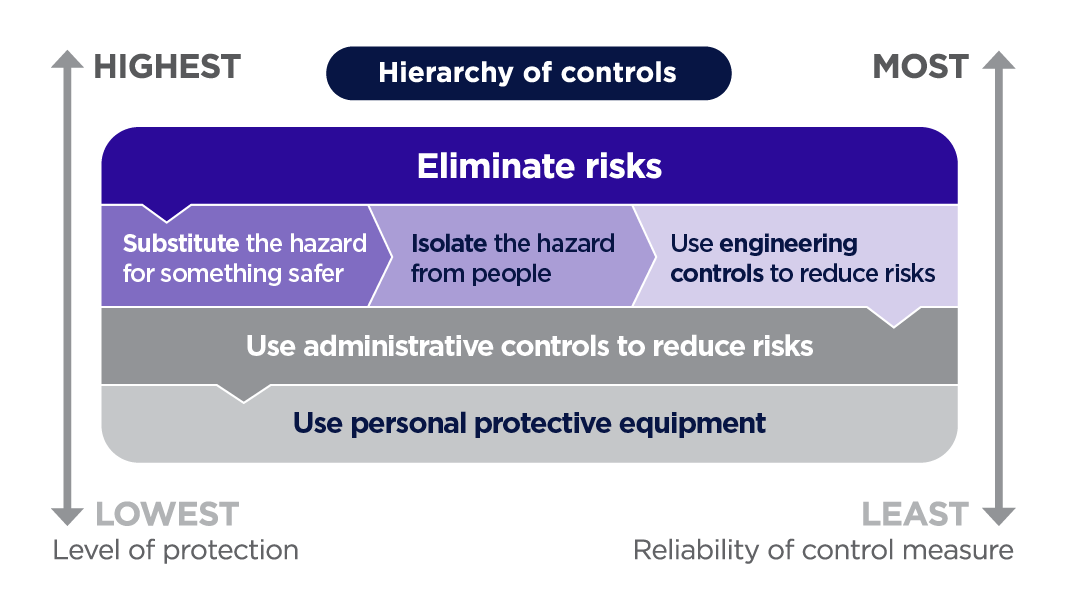
Infographic: The Hierarchy of Control Measures
You can minimise the risk of exposure to biological hazards through:
- Substitution controls, which minimise the risk of exposure to the biological hazard by replacing a hazard or hazardous work practice with one which presents a lower risk, such as:
- Replacing a higher-risk work activity with one that is lower risk (e.g. alternative cleaning methods).
- Replacing reusable equipment with disposable equipment.
- Isolation controls, which minimise the risk of exposure to the biological hazard by physically separating the source of harm from people by distance or using barriers, such as:
- Conducting high-risk work activities in specific, fit-for-purpose and isolated areas, rooms or facilities.
- Isolating waste at the point of generation into the appropriate waste storage.
- Engineering controls, which minimise the risk of exposure to biological hazards by putting in place physical control measures, including using mechanical equipment or processes, such as:
- Using an HVAC system and air filters to filter the air and improve the air quality in an indoor workspace.
- Ensuring there are adequate facilities for people to maintain good hygiene practices, such as hand washing and sanitisation facilities.
- Administrative controls, which include policies or procedures designed to minimise exposure to biological hazards and the provision of adequate information, training, instruction and supervision needed to ensure workers can work safely, such as:
- Encouraging/providing vaccination for vaccine preventable diseases that may be present in your workplace.
- Implementing cleaning, disinfection and sterilisation processes, both routinely and following a known or potential exposure in the workplace.
- Personal Protective Equipment (PPE), which is designed to minimise the risk of exposure, such as:
- Using repellent to minimise the risk of mosquito bites.
- Using appropriately fitted and suitable respiratory protective equipment to prevent the inhalation of small particles that may contain a biological hazard transmitted through the air.