As a PCBU, you must, so far as is reasonably practicable, eliminate risks associated with using quad bikes. This involves:
- identifying hazards – find out what could go wrong and what could cause harm.
- assessing risks if necessary – understand the harm each hazard could cause, how serious the harm could be and the likelihood of it happening.
- controlling risks – implement the most effective control measures that are reasonably practicable in the circumstances.
- reviewing control measures to ensure they are working as planned.
Alternative vehicles to quad bikes
Before you use a quad bike, consider whether it’s the right vehicle for the job. You may find these other vehicles safer and more suitable for some jobs:
- side-by-side vehicles – the operator stays seated and they have additional safety features like seat belts.
- motorbikes – their mobility and lighter weight makes them ideal for some tasks.
If you cannot eliminate risks associated with quad bikes, you must minimise the risks, so far as is reasonably practicable. Below are some considerations for minimising the risks of quad bikes in the workplace.
Ride quad bikes on flat, stable terrain
Quad bikes should be operated on flat terrain due to their high centre of gravity. You increase risk by riding them on rocky, steep, uneven, sandy or muddy terrain.
Do not let people under 16 years old ride adult quad bikes
Almost 1 in 6 fatal quad bike incidents involve people under 16 years. You should never allow people under 16 to ride adult-sized quad bikes.
Do not carry passengers on single-operator quad bikes
Carrying passengers on single-operator quad bikes increases the risk of rollover incidents. Passengers should only be carried on quad bikes specifically designed to take passengers.
Avoid towing attachments or carrying loads if possible
You could make your quad bike unstable and lose control from:
- towing attachments
- carrying loads on front or rear racks
- carrying liquid loads which shift as you turn corners or go up and down slopes.
Avoiding these reduces the risk of rollover accidents.
Use active riding techniques
Active riding techniques help you stay stable :
- shifting your body weight appropriately when cornering and going up and down hills
- keeping both hands on the handlebars, and
- keeping both feet on the footrests.
Wear a helmet
Always wear a helmet that fits well when riding a quad bike.
If you ride on a public road, you must wear a helmet that complies with:
- AS/NZS 1698:2006: Protective helmets for vehicle users
- United Nations Economic Commission for Europe (UNECE) Regulation 22.05
These helmets meet the requirements for on-road and off-road use.
Using quad bikes on public roads
You cannot get your quad bike unconditionally registered for use on public roads. Quad bikes don’t comply with the national standards for road vehicle safety (Australian Design Rules).
If you need to use your quad bike on a public road, for example, to travel between farms, contact your state or territory government department.
Operator protection devices
From 11 October 2021, the Consumer Goods (Quad Bikes) Safety Standard 2019 requires operator protection devices (OPDs) to be fitted to:
- new general use quad bikes
- imported, second-hand, general-use quad bikes.
OPDs reduce the risk of serious crush injuries and deaths if a quad bike rolls over.
If you buy a quad bike fitted with an OPD, you should not remove it.
If you remove it, you must replace it with something that would provide equivalent or greater protection, such as another type of OPD.
For more information on the Consumer Goods (Quad Bikes) Safety Standard 2019, please visit the Australian Competition and Consumer Commission’s website.
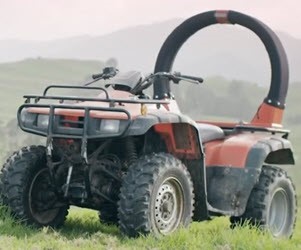
A quad bike fitted with an OPD. Image courtesy of the ACCC.
Training
Quad bike training helps riders understand quad bikes risks and active riding techniques. You can get general training from:
- quad bike suppliers
- quad bike manufacturers, and
- industry training providers.
You and your workers can also do training in a national unit of competency to operate quad bikes through a registered training organisation (RTO). When you finish the training, the RTO will issue a statement of attainment (or equivalent).
A WHS regulator may ask to see a statement of attainment or equivalent to prove you or your workers know how to safely operate a quad bike.
Depending on your circumstances, informal ‘on the job’ training may also be useful.
Some states and territories offer subsidised training. Contact your WHS regulator to see if you’re eligible and for more details.