A crane is a plant item used to:
- raise or lower a load
- move a load horizontally.
Cranes can be:
- fixed (tower, bridge, gantry, portal boom and vessel-mounted)
- mobile (slewing, non-slewing and vehicle loading).
Some powered mobile plant, like telescopic handlers, can be used as a crane when appropriate risk controls are implemented.
As a person conducting a business or undertaking, you have a duty to keep workers and your workplace safe from the risks of cranes. Everyone must work together to ensure cranes are both safe to use and used safely.
Choosing a crane
Choosing the right crane is not just important for getting the job done. It also affects worker safety.
Some cranes must be registered, and you need a high risk work licence to operate most.
Before you choose a crane, discuss your needs with suppliers. They can help you find the best crane for your workplace and the work.
These are some things to consider when choosing a crane:
- how old it is
- how long you will keep it
- how often you will use it
- the conditions in which you will use the crane
- the maximum load the crane is designed to lift safely
- whether you need a crane only or you also need a trained and licensed crew.
Some of the things to look for on the crane include:
- safe access points – ladders, footholds, steps and grabs rails
- seat design – comfort and back support
- visibility – mirror, window and windscreen design
- environmental controls – temperature control units to avoid worker heat stress.
With any crane, you have work health and safety (WHS) duties and must identify and manage risks.
Tower cranes
Tower cranes have their own model Code of Practice.
Safe Work Australia crane licensing review
In May 2021, WHS ministers agreed to Recommendation 33 of the 2018 Review of the model WHS laws to review high risk work crane licence classes, to ensure they remain relevant to contemporary work practices and equipment.
Between May and June 2022, Safe Work Australia sought stakeholder views on high risk work licensing for cranes through the release of a discussion paper.
The submissions received are available on our online consultation platform, Consultation Hub.
In response to the first phase of the crane licence review, on 5 December 2025, Safe Work Australia published amendments to the model WHS regulations to:
- remove the encompassment of certain types of high risk work (the operation of vehicle loading cranes, non-slewing mobile cranes, and reach stackers) from the scope of slewing mobile crane licences, and
- add a requirement to hold a dogging qualification as a prerequisite for certain crane licences.
The amended model WHS Regulations and explanatory statement were published on 5 December 2025.
In 2024, Safe Work Australia undertook further public consultation on additional improvements to crane licensing. This consultation explored a broad range of issues raised during the 2022 consultation, including the need to modernise the crane licensing framework in the model WHS laws in response to technological advancements and evolving industry practices.
The second discussion paper and submissions received are available on our online consultation platform, Consultation Hub.
Following this consultation, in March 2025, Safe Work Australia Members agreed to:
progress a small number of minor and technical amendments to the model WHS Regulations to:
clarify that cranes positioned and operated on a vessel require the same high risk work licence as when operated on land, and
include examples of powered operations for bridge and gantry cranes, and
consider additional crane licensing reforms through regulatory impact analysis.
The regulatory impact analysis is being conducted in two stages. The first stage will assess the impacts relating to:
introduction of a new high risk work licence for piling rig operation
introduction of a new high risk work licence for general use telehandler operation
introduction of a new high risk work licence for telehandlers used as a crane
removal of the current 3 tonne threshold for high risk work licences for non-slewing mobile cranes
reducing the high risk work licence threshold for vehicle loading cranes from ‘10 metre tonnes or more’ to ‘1 tonne’
merging the high risk work licences for tower cranes and self-erecting tower cranes into a single licence category, and
introduction of a separate high risk work licence for tower crane remote operation.
The second stage will assess impacts of options to improve the safety of:
earthmoving machinery used for lifting operations
crane operation in the maritime industry, and
slewing mobile cranes.
The second stage will also assess the impact of introducing logbook training requirements for crane high risk work licences.
Feedback on the impact analyses will be sought through public consultation during 2026.
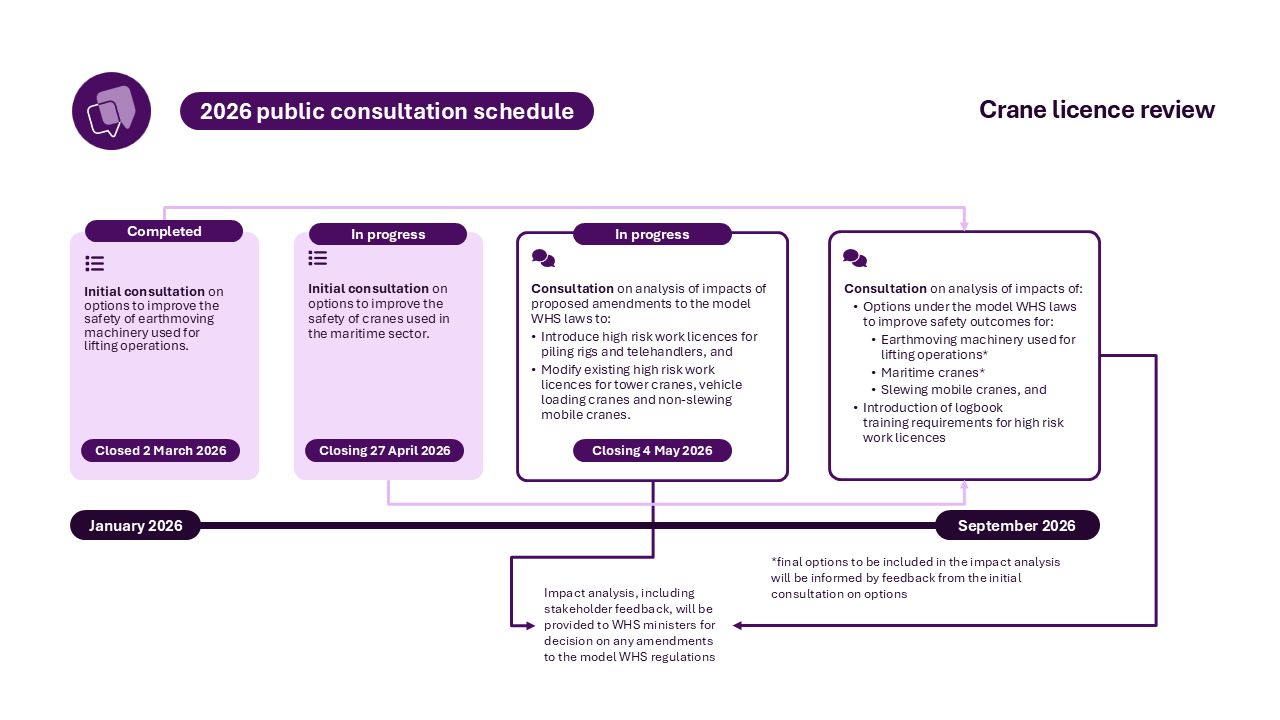
Following the consultation process, the impact analyses, including stakeholder feedback, will be provided to WHS ministers to inform their decisions on the proposed reforms.
Stay updated
Subscribe to the Safe Work Australia mailing list to receive alerts and updates.